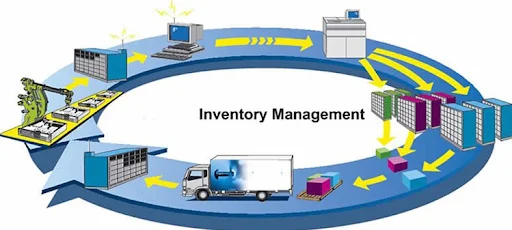
Inventory management is all about getting the balance right; making sure you offer the right selection of products and services to the right customers while minimizing cash and costs. An example of this could be social media services in Dubai, offering a multiplicity of services at a low cost and high sales. Bindo is the one-stop retail solution for local retailers. It’s an iPad/iPhone point-of-sale (POS) system, which makes it incredibly easy for merchants to add and manage inventory in the cloud, and enable in-store purchases to be processed with greater efficiency and speed.
Whether it is a social media company in Dubai or a small business, companies usually have a substantial amount of capital invested in inventory. If your business isn’t using proper inventory management, your products can suck your cash instead of turning in profits. 43% small businesses in the US still use manual systems to track inventory, according to the State of Small Business Report, which can lead to mishandling, inaccuracies, errors, shipping mistakes, and misinformation about your stocks, leading to potential losses.
It is always a good idea to improve inventory management and tighten your control over the predictability of sales. This may prove difficult since inventory requires warehouse capacity, planning, and investment, but it is worth the money because it leads to increased potential profits.
Here are some tips to follow to improve your inventory management.
1. Cycle Counting
The need for cycle counting is integral in order to manage inventory. Instead of carrying out an annual full count, the use of cycle counting to audit inventory is much more beneficial since it spreads reconciliation over the year, while traditional counting forces operations to stop, proving to be disruptive to daily processes.
Cycle counting is when, each day, week, or month, small subsets of products are checked on a rotating schedule over a period of time. However, one must consider factors such as counting frequency, finding a trusted employee to manage the count system, as well as the effects of counting on manufacturing and delivery processes.
Cycle counting provides a good assessment of product accuracy and can be adjusted to focus on higher value items or those critical to business at particular times. It is a good method of validating accuracy and rectifying errors.
2. Track access to inventory
An important tip to retain is to ensure that limited people have access to managing inventory. Only a few handpicked employees should be able to influence the inventory. By knowing the limited people who have access, companies can ensure proper training regarding organizational system practices. Management becomes much more efficient, and errors are reduced.
A company should ideally decide who has access to inventory management when the system is first established, but this shouldn’t be a rigid number of staff. Annual examination of who should have access might suggest it is useful to add or subtract people from the exclusive list to ensure maximum productivity.
3. Stock level controlling
Setting par levels is another useful practice that companies should adopt since it makes inventory management easier for each product. Par levels are the minimum amount of a product that must be stored at all times, so that when your stock dips below this level, it acts as an indication to order more. Usually, par levels vary in accordance with each product’s sales and the time it will take to accumulate stocks.
Though this process of controls requires research, planning, and efficient decision-making, setting par levels is a good, systematic practice of inventory maintenance, as it also allows your staff to make decisions on your behalf. It should also be noted that par levels aren’t absolute. They need to be updated and changed over time to make sure they are still applicable; owners shouldn’t hesitate to re-adjust the levels if the need arises.
4. First-in, First-out (FIFO)
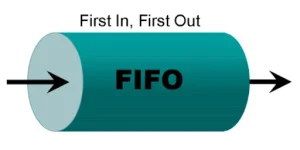
The ‘First-in, First Out’ or FIFO principle is of utmost importance in inventory management. It refers to a situation when your oldest stocks are sold first instead of newer stocks and is particularly integral for the distribution and storage of perishable goods or goods with early expiry dates, so that the company doesn’t have to deal with unsellable spoilage or a waste of resources that can have a negative impact in the long run.
FIFO is also practiced for non-perishable goods in order to allow room for adjustments in packaging design and feature changes; companies don’t want to end up with something unfashionable that they can’t sell anymore.
The management of FIFO requires an organized warehouse and systematic planning, which ensures that old products stay in the front
5. Prioritize with ABC
The use of an ABC analysis helps a business prioritize certain products in its inventory management; it can separate products that require more attention. This is done by categorizing products thoroughly into three types: the high value products with low frequency of sales, moderate value products with moderate frequency, and products with a low value and high frequency of sales, all in accordance with the law of demand assumption. Each category requires varying levels of attention. For example, high-value products need meticulous observation because their profits are substantial, but sales are unpredictable. Low-value products are often paid less attention to because of their relatively less financial impact.
6. Quality control

Quality control is of immense importance in a business and must be ensured for maximum customer satisfaction and business growth in economic terms. Quality consciousness should be implemented as early as possible. This can be done easily through a checklist of procedures employees will need to adhere to when checking goods, such as signs of damage (leaks or tears), whether the product matches the color and style of the purchase order, and the terms of sale. The shared list of common goals is not efficient, but it also makes sure that all workers are on the same page, and this will inevitably increase productivity. If certain products don’t meet company standards, workers immediately return them to suppliers, hence making this inventory practice effective as it eliminates the need to pile up stock levels and reduces errors. When discussing quality, the storage environment must be considered as well, which will include variables such as light, humidity, and temperature.